

Free to quit:
Freedom from nicotine
Ready to Quit Nicotine? We’re here to Help.
SAY GOODBYE TO SMOKING, VAPING, SNUFF, CHEW, & POUCHES FOR GOOD.
Quit nicotine and free up more than $2,000 a year—enough to fund a road trip adventure, pay down debt, finance a new hobby, or invest in your financial future. At BCBSWY we flip the script; instead of thinking about what you’re giving up, let us show you what you gain with quitting.
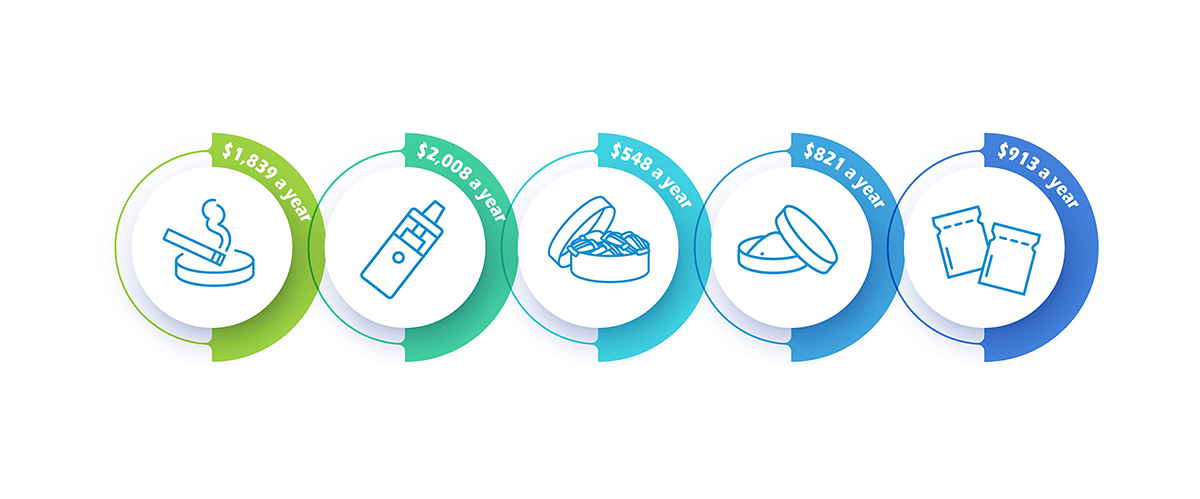
What are nicotine products really costing you?
Nicotine products aren’t just addictive—they’re expensive. When you tally up the cost of daily nicotine use, the numbers are staggering. Here’s a breakdown of average annual costs based on typical use:
How does bcbswy help you quit?
- Office visits related to quitting nicotine are covered by most BCBSWY health plans and may be covered at 100%. If you have questions about coverage, please call Population Health.
- Nicotine replacement therapies (NRTs) like gums and patches are helpful tools on your journey to quitting and covered at no cost to most BCBSWY members. To qualify, the gums or patches have to be on the approved list found at www.myprime.com.*
- We work with QuitWyo to get you quit kits with tools to help you quit and connect you with national counseling services to support your through your quitting journey.
Nicotine hooks you—whether it’s a pouch or a pack
Nicotine pouches have become as popular as vaping and other nicotine-containing products. They come in numerous flavors and are easy to use, which has made them a popular choice for younger nicotine users. The small, rectangular bags of nicotine powder are placed between a person’s lip and gums to deliver nicotine. There is a misconception that nicotine pouches are safer than cigarettes or chewing tobacco, but that is 100% incorrect. Nicotine pouches are still highly addictive and can cause significant health problems.
FACT: Vaping is not ‘safer’ than smoking.
Vaping delivers addictive nicotine and harmful chemicals that can damage your lungs, heart, and brain. It’s not a safe alternative to smoking—just a different way to put your health at risk.
Prolonged use of any nicotine product can impact your physical and mental health, contributing to:
Heart Problems: Nicotine use, whether in pouch or another form, raises your heart rate and blood pressure, leading to an increased risk for developing heart disease.
Oral Damage: Nicotine irritates the gums, harms soft tissue, increases cavity risk, and may cause gum issues.
Mental Health Illness: Nicotine use is linked to increased anxiety, stress, mood swings, and risk of developing addiction to other substances.
Harms Brain Development: The use of nicotine is linked to brain damage, particularly in younger users. Nicotine can harm the development of areas of the brain that control attention, mood, and impulse control. This is a particularly big risk for younger users who use nicotine pouches.
Harms Pregnant Women and Infants: Nicotine use in pregnant women can harm the development of fetus, even if no tobacco is present in the product, and can cause birth defects and serious complications in labor.
Unknown Long-Term Effects: The reality is that nicotine pouches are a new product, the long-term side-effects and risks of which are unclear. Recent studies have shown that nicotine pouches contain harmful chemicals like formaldehyde (a chemical used in embalming fluid and glue) and heavy metals, many of which are cancerous or thought to increase risk of cancer.
Questions About Quitting?
If you need additional support to quit smoking, vaping, snuff, chew, or pouches:
Call: 1-866-204-7132
Email: [email protected]
Contact our Partners at QuitWyo: Call: 1-800-QUIT-NOW
(1-800-784-8669)
Visit: www.quitwyo.org
WHAT HAPPENS WHEN YOU QUIT?

20 minutes after quitting
Heart rate and blood pressure drop: Your heart rate and blood pressure start to normalize as your body adjusts to the absence of nicotine.

8 hours after quitting
Oxygen levels increase: Carbon monoxide levels in your blood decrease, and oxygen levels begin to rise to a healthier level.
Nicotine levels begin to drop: Nicotine levels in your body start to decrease significantly, which may cause withdrawal symptoms like cravings, irritability, and mood swings.

24 hours after quitting
Risk of heart attack drops: Your risk of having a heart attack begins to decrease as the toxic effects of nicotine begin to subside.
Oral health improves: If you were using oral nicotine like chewing tobacco or pouches, your gums and mouth begin to heal, and your risk of developing gum disease and oral cancers starts to decrease.

2 days after quitting
Nerve endings regenerate: Your sense of taste and smell improves as nerve endings in your mouth and nasal passages begin to regenerate, and your overall sensory experience becomes sharper.

3 days after quitting
Breathing becomes easier: Your bronchial tubes relax (for smokers), and if you used chew, the irritation to your throat and gums begins to subside.
Nicotine withdrawal peaks: Nicotine withdrawal symptoms—such as anxiety, cravings, irritability, and restlessness—may peak during this time but begin to lessen as your body adjusts.

2 weeks – 3 months after quitting
Improved circulation and lung function: Blood circulation improves, and lung function increases the longer you go without smoking, making physical activities easier.
Gum and mouth healing: If you used smokeless tobacco or nicotine pouches, you may notice improvements in your gums and teeth as they heal from the exposure to harmful chemicals. You may also start to notice less dry mouth, which is common among tobacco users.

1 – 9 months after quitting
Lung and oral health improvement: Former smokers will see continued lung healing, with less coughing, less mucus production, and reduced shortness of breath. For former oral tobacco users, the risk of oral cancers (throat, mouth, and gum cancers) continues to decline.
Mental clarity improves: Nicotine reduces cognitive function for many people, so quitting leads to improved focus, memory, and mental clarity.
2 weeks – 3 months after quitting
Improved circulation and lung function: Blood circulation improves, and lung function increases the longer you go without smoking, making physical activities easier.
Gum and mouth healing: If you used smokeless tobacco or nicotine pouches, you may notice improvements in your gums and teeth as they heal from the exposure to harmful chemicals. You may also start to notice less dry mouth, which is common among tobacco users.

1 year after quitting
Risk of heart disease cut in half: Your risk of coronary heart disease drops to half of what it was when you smoked. Smokeless tobacco users will notice a dramatic reduction in the risk of gum disease and oral cancers.
Oral health continues to improve: For former smokeless tobacco users, your mouth continues to heal, and you may experience fewer issues with bad breath and gum disease.

5 years after quitting
Reduced risk of stroke: For both smokers and chewers, the risk of stroke significantly decreases to about the same level as someone who has never smoked or used tobacco.
Oral health stability: Your mouth continues to heal, and if you had gum damage or any signs of early-stage oral cancers, the healing process should be well underway by now.

10 years after quitting
Risk of lung cancer drops: The risk of lung cancer for former smokers drops by about half, and for those who used chewing tobacco, the risk of oral cancers drops significantly.
Continued improvement in oral health: Oral tobacco and nicotine users may have fully healed gums, and the chances of developing oral cancer or gum disease are much lower now.

15 years after quitting
Heart disease risk is similar to that of a non-smoker: For former smokers, the risk of coronary heart disease is now equivalent to someone who has never smoked.
Oral cancer risk greatly reduced: For those who quit chewing tobacco or pouches, the risk of developing oral cancers and other related conditions continues to be much lower compared to active users. The long-term healing of the mouth and gums has likely reached a stable point.
Questions About Quitting?
If you need additional support to quit smoking, vaping, snuff, chew, or pouches:
Call: 1-866-204-7132
Email: [email protected]
Contact Our Partners at QuitWyo:
Call: 1-800-QUIT-NOW
(1-800-784-8669)
Visit: www.quitwyo.org